Viking Service in a Downtown Bellevue High-Rise
Tower kitchens change how a Viking fails and how it gets fixed: a sealed galley under a strong hood starves the smallest flame, and the visit itself runs on the building's rules. What we usually find, and how to plan the day.
A Viking range in a downtown Bellevue condo does the same job as one in a house on a large lot. What is different is everything around it: a galley kitchen with no window worth opening, a hood sized to clear a lot of steam in a small space, walls and glazing built to keep the weather out, and a building with its own rules about who comes up in the elevator and when. Those surroundings account for a fair share of the calls we take from the towers, and they shape how the visit runs.
This guide covers both halves: the faults that tower kitchens produce more often than houses do, and what to sort out before a technician arrives.
The simmer flame and the hood
The pattern we meet most in tower units is a simmer burner that holds perfectly well until the hood goes to high, then flickers and goes out. Owners reasonably suspect the burner. Most of the time the burner is fine.
A hood that vents outdoors removes air from the apartment. In a house that air is replaced through a hundred small gaps. In a modern tower unit, sealed for energy and sound, there are far fewer of them, so the room drops very slightly below the pressure outside and replacement air comes in wherever it can, sometimes past the cooktop. A full-size flame shrugs that off. A burner turned right down to simmer does not.
Two owner checks separate air from burner, and neither needs a tool:
- Light the simmer, then turn the hood to high with a window or the front door open a crack. If the flame now holds, the burner is healthy and the answer lies in air supply, not in the range.
- Run the hood on a lower speed while simmering. If the flame is steady there and only fails at full speed, you are seeing the same effect.
If the simmer drops out with the hood off and the room open, the fault is in the range, and that is a burner visit: a cap sitting off its seat, a partly blocked port, or a flame that has lost its shape. It is worth saying which of these tests you have tried when you call, because it tells us whether to look at the burner or at the room.
Recirculating hoods, the type that filters the air and blows it back into the kitchen rather than ducting it outside, do not pull a room negative in the same way. If yours recirculates and the simmer still fails when it runs, look elsewhere first.
A hood that roars and barely pulls
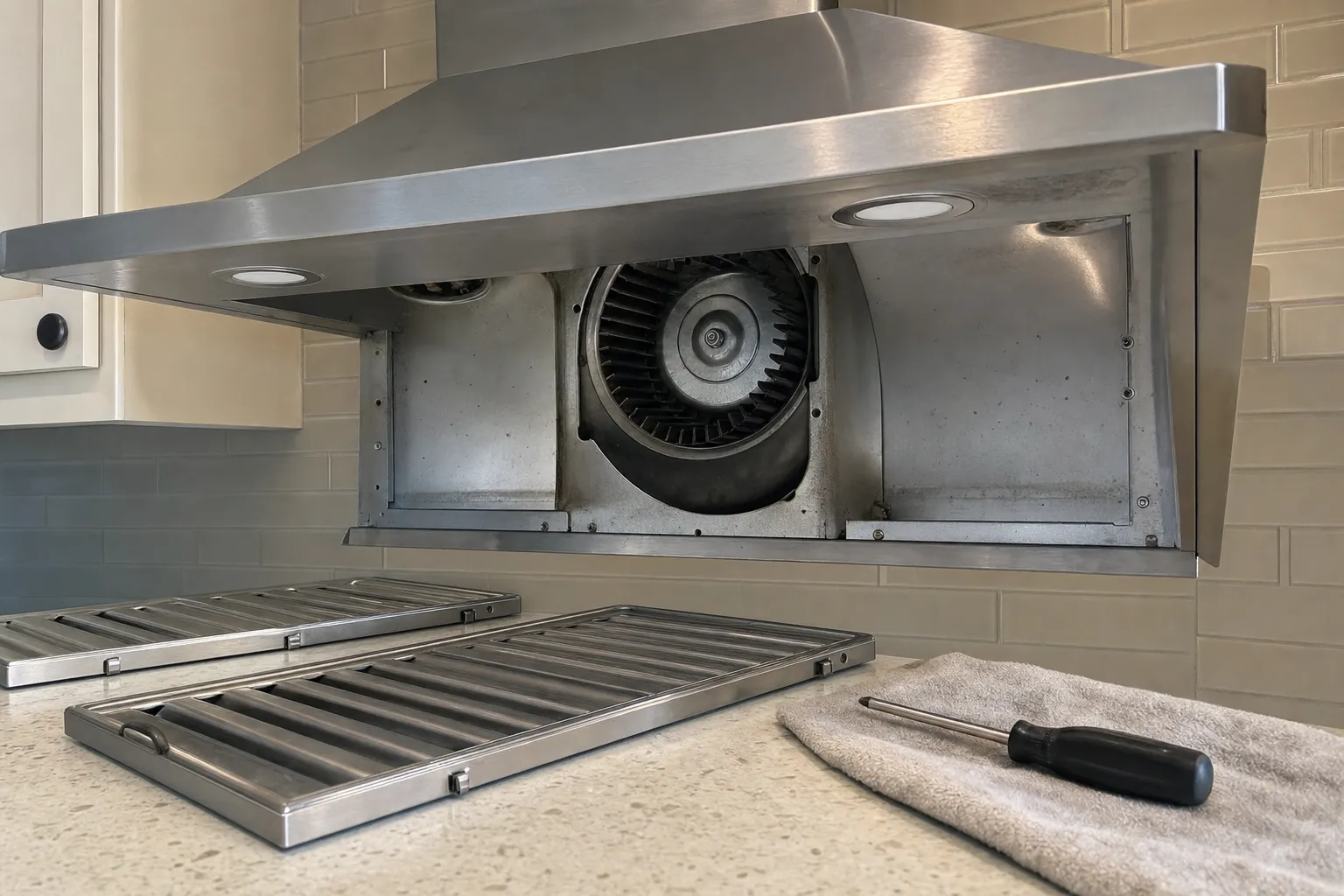
The second tower pattern is the reverse complaint: plenty of noise, very little suction, steam hanging at the ceiling. Before the fan motor gets the blame, check the filters. Baffle and mesh filters load up with grease faster than most people expect in a kitchen that cooks every day, and a clogged set turns a strong hood into a loud one. Most slide or drop out by hand and go through a dishwasher or a hot soak.
If the hood recirculates, it also carries charcoal filters, which do not wash and do wear out. A spent set leaves cooking smells hanging even when the fan sounds healthy.
Clean filters and still no pull, or a fan that has changed its sound, is a visit. The hood’s lights working while the fan does nothing is a different fault again, usually electrical, and also a visit rather than a do-it-yourself job.
Galley kitchens and the rest of the appliances
Tower units tend to pack a range or a cooktop and wall oven, a column or built-in refrigerator and a panel-front dishwasher into a single wall or a narrow U. The appliances are the same Viking models found in houses; the space around them is smaller. That matters in two ways.
First, heat and moisture have fewer places to go. A dishwasher door opened at the end of a hot cycle sends steam straight up the neighbouring cabinet fronts, and a refrigerator set close to a range or oven works a little harder than one with more room around it. Neither is a fault, but both are worth knowing when an appliance starts to behave oddly.
Second, working room is short. A technician in a galley cannot spread parts across a spare counter, so the phone call does more of the work than usual: the model, the symptom and what has been tried let the visit start with the likely parts rather than a second trip down to the car.
Before the visit: the building
Buildings in downtown Bellevue handle contractors in different ways, and your concierge or building manager is the one who knows the rules for yours. The questions that come up most:
- The elevator. Some buildings want the service elevator reserved for any contractor carrying tools or parts. Ask whether yours does and how much notice it needs.
- Where to park and unload. Downtown street parking is tight at the best of times. If the building has a loading area or visitor spaces, say so when you book.
- Paperwork. Some associations ask contractors for proof of insurance before they will let them up. If yours does, mention it early so it is not discovered at the front desk.
- Access. Whether someone will be home, or the concierge will let the technician in.
None of this changes the price of the visit. It changes whether the visit starts on time, and ten minutes at the front desk sorting a permission that could have been sorted by email is ten minutes nobody enjoys.
When to call rather than wait
A simmer that fails with the hood off, a burner that clicks without end in a dry kitchen, an oven that runs cold, a refrigerator warm on one side: none of those will fix themselves in a tower any more than in a house. A smell of gas with every knob off is different again. Leave the unit, tell the building and call the gas utility from outside before calling anyone about the range.
For everything else, describe what the appliance is doing, which checks above you have already made, and the building’s name. From that the likely cause is usually clear before anyone sets out.
Follow-up questions
-
Does a visit to a tower unit cost more than one to a house?
No. The visit and diagnosis are the same $89 anywhere in Bellevue, and they come off the repair once you approve it. What a tower changes is the planning: the elevator, the loading area and any paperwork the building asks for. Give Viking Repair Bellevue the building name on (425) 696-2636 and the day is arranged around it.
-
My simmer burner only goes out when the hood is on high. Is the burner faulty?
Usually not. A tight apartment with a strong hood running flat out pulls the room slightly below the pressure outside, and the smallest flame on the range is the first thing to feel it. If the simmer holds with a window cracked open, the burner is healthy. If it still goes out, call Viking Repair Bellevue on (425) 696-2636.
-
Can the range be pulled out in a galley that narrow?
Most range faults never need it: burners, igniters and switches are reached from the cooktop, and much oven work from the cavity. When a range does have to come forward, the floor is covered and the counters are protected first, and you are told before it moves. Viking Repair Bellevue plans this on the phone at (425) 696-2636.