Range and rangetop · Bellevue
Viking Griddle Heats on One Half Only
The plate is almost never the problem; what is under it usually is. On a single griddle the burner beneath is lighting along only part of its length. On a double one, each half has its own knob and its own burner, so a cold half often turns out to be a knob nobody turned. If the checks below change nothing, Viking Repair Bellevue is on (425) 696-2636.
What we usually find
- Most often
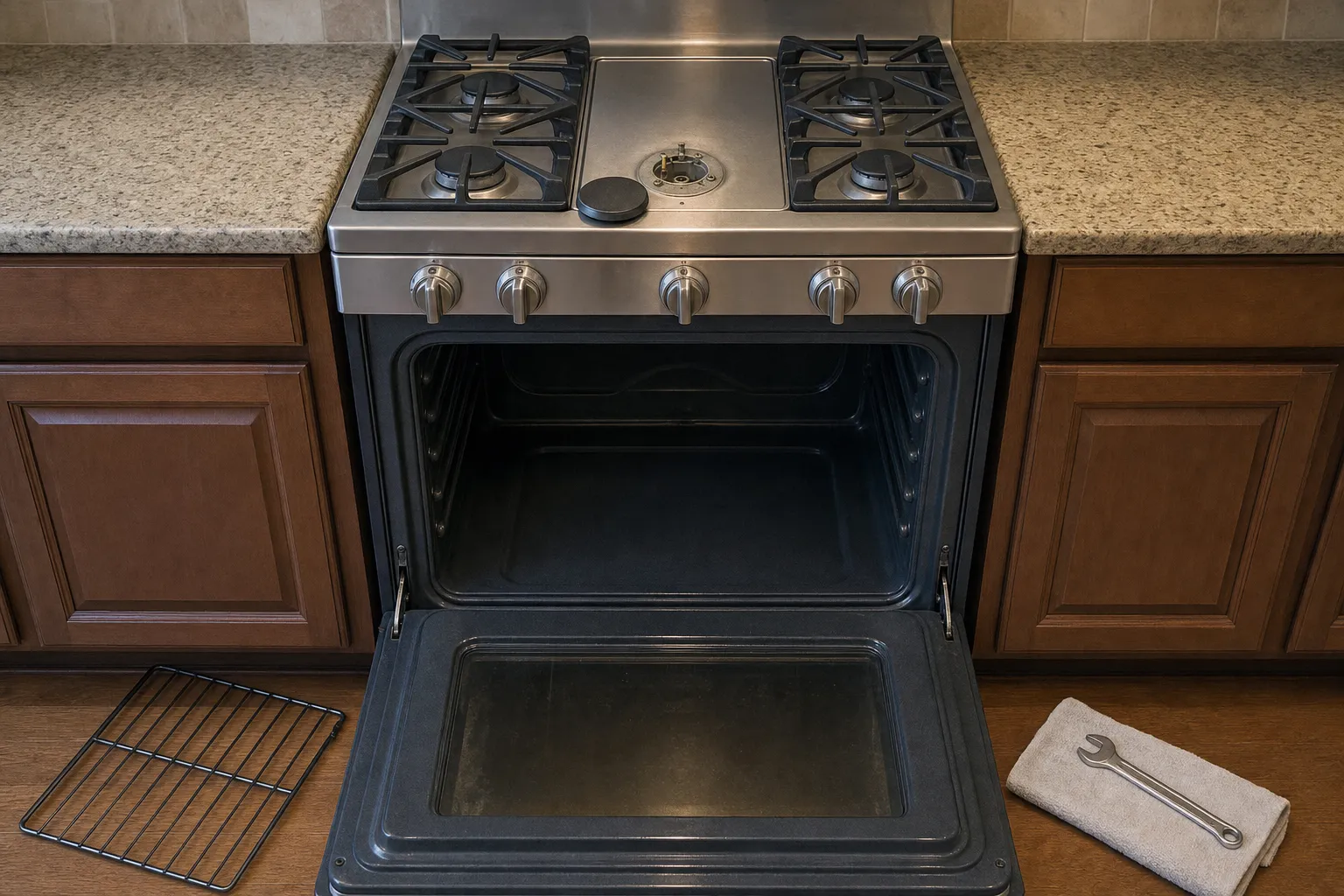
Ports blocked along one stretch of the burner beneath the plate. The flame runs only part of the way across, and that end of the griddle never catches up with the rest.
- Sometimes
On a range with a double griddle, one half has its knob off, or that half's own burner or thermostat has quit. Viking runs each half from a separate knob and a separate burner.
- Rarely
Too little gas reaching the burner: a part-blocked orifice, or an air setting disturbed in an earlier repair. The flame shrinks along its whole length but shows first at the far end.
One side cold, not the whole plate
A thick griddle plate spreads heat well, so a half that stays cool is a sign that heat is not arriving there at all. Viking’s range griddles are gas-fired from underneath, with an electronic thermostat meant to hold the whole surface at the setting. A little fall-off right at the rim is ordinary on any griddle; a whole half lagging is not, and one that stays at room temperature usually has no flame under it at all.
A habit worth dropping
Never cool a hot griddle with a splash of cold water. Viking warns that the shock warps the plate and, repeated, can crack it, which adds uneven cooking of its own.
What the technician works through
With the plate lifted, the technician watches the flame along the burner’s full length, clears or replaces what blocks it, and checks the igniter and the gas supply. That work falls in the band shown below; a thermostat, if that is the part, is quoted after the diagnosis.
Safe checks before you call
-
Match every griddle knob
If your griddle has two knobs, each half answers to its own, so set both to the same temperature. With one knob, turn it to a real setting rather than just off the stop.
-
Wait for the heating signal to settle
Most Viking griddles show a light, or a pulsing ring around the knob, while the plate heats, and it goes out or holds steady at temperature. Judge the cool side only after that point.
-
Map the cold patch with bread
Lay slices of plain bread edge to edge across the heated plate for a minute or two. The toasting pattern shows exactly where the heat stops, and a photo of it saves time on the visit.
-
Leave the plate in place
Empty and wipe the grease trough at the front as usual, but do not lift the plate or reach beneath it. The burner, its igniter and the thermostat sensor all sit under there.
-
Stop and hand it over
If none of that changes what the Viking is doing, leave it there and ring Viking Repair Bellevue on (425) 696-2636. Tell us what you already tried; it narrows the visit before we set out.
Asked about this
Can I keep cooking on the hot half until the repair?
If the working side heats normally and there is no smell of gas, using it until the visit is generally fine, just with less room. Stop if you see flame escaping round the plate or hear clicking that never ends, and leave the house if you smell gas. Viking Repair Bellevue diagnoses the cold side on (425) 696-2636.
Why is my Viking griddle dead while the oven self-cleans?
On Viking's self-cleaning Professional ranges with a griddle, the manual says the griddle does not work while the oven runs its clean cycle. That is intended, not a fault, and it should heat again once the cycle has finished. If it stays cold after that, ring Viking Repair Bellevue on (425) 696-2636 and mention the self-clean.